When I was Competitor Analysis Manager for Land Rover Ltd, I managed to test, measure and write about all the conceivable Land Rover competitors. It was mostly utility vehicles and luxury SUVs. In 1987 or so, I tested the Suzuki SJ410, a 1.0L version of the car that later was to have a 1.3 L engine. This vehicle I duly took to the Test Hill. I ascended the 1 in 3 concrete test hill nearby to the body shop and did my usual ascent and descent. Ascent was always entertaining, because one’s horizons were effectively, unlimited, because at that sort of gradient, one is looking at the sky. The descent, however, was quite a bit different.
I always stopped the vehicle dead on top of the hill, ensured I was in the centre of the roadway engaged first gear and low range where available, and if I have an assistant, they started the clock and measured the amount of time to descend the hill in first gear.
This gave a very simple, easy comparison between vehicles. The Suzuki, fitted of course with a transfer box to send drive from the main gearbox straight to the rear axle centre differential and then step forwards to an offset differential at the front. It had available four wheel drive high, two wheel drive high and four-wheel-drive low positions as it does to this day. I then took the same vehicle on the off-road track, part of which involves driving along a line of railway sleepers tied together with steel rails that are a suitable width where most vehicles would fit.
Doing this in a post-1984 coil-sprung Land Rover would result in a pitching, tossing and rolling uncomfortable motion, if attempted at the wrong speed, i.e. too low. However, if one made a spirited drive along and across the sleepers, the unsprung of the axles and suspension couldn’t react fast enough to dropping into the gaps between sleepers and it was possible to effectively float over the rough surface.
I do well remember however my colleague Hugo, who was the engineering competitive guy driving a Volkswagen Transporter Synchro across the sleepers, and his glasses fell off because he just got into the natural frequency of the suspension. So, I took the Suzuki around the course. It was a UK car fitted with a delightful radio cassette player mounted just forward of the main gear-lever. It wasn’t very long before said radio cassette player ejected not just the cassette within, but it’s whole body from the clutches of the plastic moulding surrounding it, hanging there forlornly on its electrical wires.
I fought to reinstall the player and carry on with the test. I was a Land Rover man, so my heart was with Land Rover, and more specifically our icon of that particular course, a diesel manual Defender 90, a short wheelbase vehicle, which would just (in the right hands), glide around the course coping with the incredible side-tilt, the sleepers, the concrete steps, then ascend and descend with gay aplomb.
Now we all like a bit of gay aplomb, so technically that vehicle was my benchmark. The Suzi I was therefore tempted to dismiss, as it became cheap and cheerful in my haughty Team Land Rover mind. Time moves on and I can now see a different side to the basic Suzi, only this time, it wasn’t created in Japan, but India! Indian firm Maruti – who did a brilliant recreation of the original WW2 jeep, some of which can still be seen on the roads of the sub-continent – made them from 1986 to 2019 (for civilians, military ones are still being delivered).
On our 2023 Exodus Adventures trip to India to look for tigers, these vehicles were the most popular choice for conveying tourists around. Fitted with grandstand seating on the rear load-space, six adults could be accommodated in comfort and go looking for apex predators. Although we did find other humans, our real interest was the iconic, revered Indian tiger.
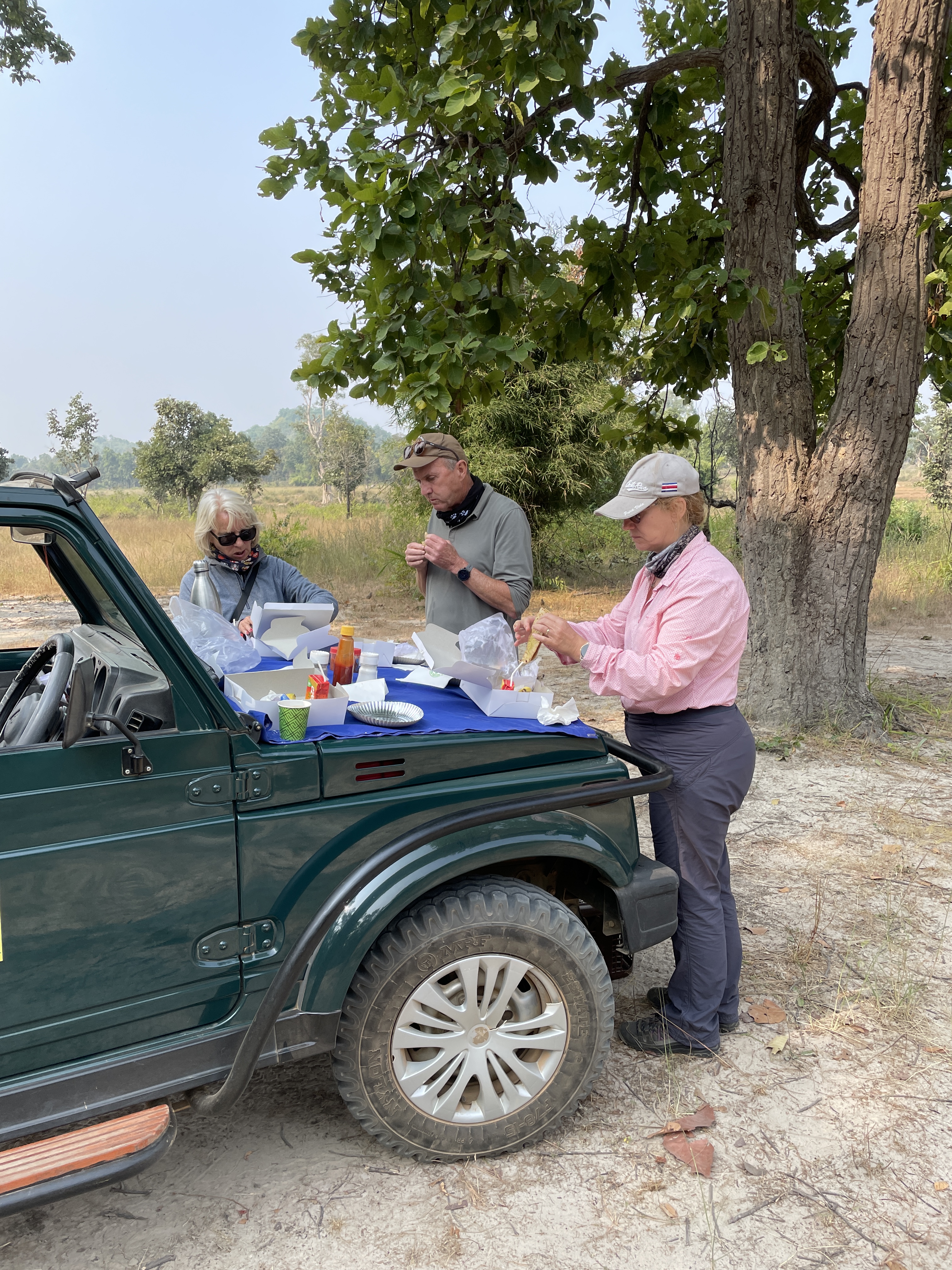
The 1.3L petrol engine and transfer box was the ideal tool for negotiating the dusty tracks of the three game reserves (Pench, Kanha and Bandhavgarh) and the occasional steep climb on slippery rocks. Even with inexpert drivers, these machines performed well, even showing a fair turn of speed (scary in the dark on Indian roads) when called to do so, after a Le Mans-style start once we had our official Guides. I didn’t hear one out of place clunk, bang or rattle from any of the basic cars. The engines were quiet and most had 70,000 km showing on the clocks, but with many showing a EML (Engine Management Light), probably as a result of being jump-started.
The open nature of the cars gave excellent all-round visibility to view the open nature that we were there to see! It also put six tasty humans on show for any hungry tiger, or rampant wild elephant. The former seemed to regard us with a feline “oh, just a bunch of nosy humans” look and the latter were to be feared as they could become seriously agitated and can move very quickly. Judging by the devastated bamboo in the jungle, they were battering rams on legs. It was good to see reverse gear functioning in the little Suzis.
So, I tip my hat to these little go-anywhere cars. Better engineered than an old `series LR or Defender in my view and less likely to bog down or lose a rear cross-member to the tin-worm. Yes, not quite as strong or capable in extremis, but for most folk, all one ever needs.

