Over to Ian Pogson for a tilting train tome:
Dr Ian Pogson
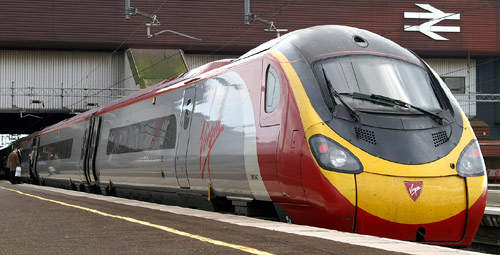
I know that this is in no way related to motorcycles or cars for that matter, but the kind person who allowed me to travel “pointy-end” to Euston in a Virgin Pendolino is a fellow two-wheeler (Guzzi Norge) – Bob (and Mary-Jane) Dunn are neighbours in the village and I bought a Guzzi 500 from M-J once upon a time. Bob is an aircraft nut as well and his garden features the fuselage i.e. cockpit of a Canberra.
Bob is a top-link driver trainer inspector for Virgin Trains and he occasionally has room for a small one in the cab when he takes a trainer for his regular assessment. So it was that I found myself in the cab, rushing towards London. There is a slight similarity to bikes in that a Pendolino leans, but only 8 degrees (plus 6 degrees for the track).
A few stats before we set off – 25kV is pumped into the overhead wires, with the train using about 1kV. The rest is there for other trains on the same section and to make up for losses. Feeds occur every 15 miles, with neutral gaps between each of these of 5 metres, so don’t stop with your pantograph in the dead zone! The gaps are marked!
Nine or 11 coaches make up the Pendolino fleet, the latter being the one we were on, which equates to about 600 tonnes. From top (allowable) speed of 125mph it takes less than a mile to stop – good brakes! It costs around £200 for the ‘leccy’ to travel to the Smoke and we used 3300kWh on the way up to London and 2200kWh on the return, as we suffered lots of small delays outward. A little green display shows the consumption figure and there is a “consumption league” for the drivers, who only know their own position in the list!
The train “sets” of 9, 10 or 11 carriages and power units are owned by Angel Trains, one of a number of rolling stock leasing companies they duly hire to Virgin and have them maintained by Alstom Engineering, so really, all that beardy Branson “owns” are the staff and the brand.
“Cab etiquette” was made plain to us – no distracting the driver, no phones and emergency exit is by the side window if there is a fire preventing normal access to the train by the door at the rear of the cab. A rope ladder is situated under the co-driver’s seat for assisting the scramble down the side of the cab!
Before setting off, there is a check on the headlights, screen washers are operated and there is an air-craft style cockpit check to be conducted by the driver, who is ultimately responsible, along with the Guard (now called a Train Manager). The driver logs on to the computer system and will have already collected his written “late update” sheet of any Engineering works and his expected times to cross other Pendolinos and any stops along the way. He “mobilises” the cab from left to right.
Just before departure, the platform staff give the first check signal to the guard (repeated on the cab instrument panel), the guard makes a check from the door in which he or she is stood and shuts the doors. The platform staff check doors again and if all the lights on the “dash” show all doors shut, the driver can look for the “RA” signal on the colour light signals on the platform. A blue light will extinguish on the dash and away we can go.
The “big knob” can be grasped, which is to the driver’s left and has 6 braking steps (plus Emergency) and 4 accelerating steps. A running brake check is done down to 2mph as soon as it is safe. The skill is to be s-m-o-o-t-h. Every 1 minute 45 seconds, the Driver Safety Pedal has to be pressed by the driver, which silences an audible alarm and proves that there is someone alive at the controls. Also, the AWS (Automatic Warning System) sings out regularly to alert the driver to adverse signals. The driver only has 2.5 seconds to respond to these; otherwise the brakes are automatically applied.
Once past Rugby, we are inside the GSM-R area, which is a direct line to the signalmen in their face-less power boxes, so regular calls can be made and received without the need in the past to stop at a signal and climb down to a ‘phone track-side. We were able to contact the Maintenance team at one point to report a pantograph fault and make a change from one to the other.
Two miles out from a scheduled stop there is another audible warning and during the whole journey, TASS (Train Authorising Speed Supervisor) watches over the speed selected by the driver, as the train is capable of 140mph, but the trackside signalling is not able to support this so 125mph remains the maximum for the time being. TASS authorises the operation of the tilt function and speed to avoid over-cooking it on curves (there have been some accidents in Europe). TASS monitors and logs speeds and all driver inputs via a “black box” recorder. Driver training takes a full 12 months to include all the tech stuff as well as signals and route knowledge.
My over-riding impression is of a group of people trying very hard to be super-smooth and on time, but our railway infra-structure is based on Victorian routes and often laid by competing train companies in the early 1800’s is not up to modern demands. The WCML (West Coast Main Line), effectively handling the lion’s share of the nation’s freight, is over capacity now. There is a real need for HS2 to allow better use of the current tracks for more local use. Beeching was a little pre-emptive in closing the Great Central line up the middle of the country, which would have obviated the need for HS2.
As for the actual trip, the speed was astonishing, truly. Line-side equipment and people appear and woosh by so fast, yet drivers are expected to see small boxes between the rails and temporary speed restriction signs to assess what is going on and where they are. There is a lot happening really fast at 125mph. We were up to 100 before you could blink, so Birmingham International station was reached very quickly. Tragically, the preceding Central Trains departure was late and caused a domino effect with us in their immediate wake. Also, as there is no passing loop between New St and Coventry, we were unable to accelerate past, hoping (but failing) to pass them at Rugby.
So much of the useful railway links between our towns and cities were removed by the ill-advised and badly led Dr Richard Beeching (his boss, Earnest Marples was a road-builder!!), that we have so few “by-passes” that essential maintenance has to take place in a very small window between the last night train and the morning first. Otherwise one is stuck trailing a slower train. It is agreed between companies like Chiltern Trains and Virgin that the other will accommodate when one is in need of a serious route closure.
It was disappointing to arrive late at Euston, but the return trip was so much more to plan and we actually coasted from Rugby to Coventry! Momentum gained is not happily wasted by these people – think of the league table! I was impressed by the standard of care and gentle control of the 600 tonnes behind us, by the concentration levels and the attention to line-side detail. Thanks, Bob.
Some Pendolino Facts:
- Manufacturer: Alstom Engineering & Fiat Ferroviaria
- UK Classification: B.R Class 390 & 390/1
- Date First in Service: July 2002
- Built: UK from 2001 – 2005 then Italy from 2010 – 2012
- Fixed sets of either 9 or 11 car units
- Propulsion: Onix traction motors via overhead wire at 25,000 volts AC
- Power output: 6920hp (390/0) or 8070hp (390/1)
- Maximum design speed: 140mph – limited to 125
- Braking: Electro-pneumatic disc brakes and rheostatic regeneration via the traction motors
Editor’s Note: Readers of a discerning taste will notice that the West Coast Mainline route these days is operated by the (in my opinion) shambolic AVANTI WEST COAST company, not Virgin Trains, and has been since 2019. It’s taken a while to nudge Dr Pog into doing this. But well worth the wait I feel (MAH)

